
As EVs, grid storage, and wearable electronics converge into a $100 billion energy storage market, graphene and GQDs are the catalysts that makes the next leap possible.
Graphene-GQD supercapacitors don't compete with batteries — they complete them, bridging peak power demands and recovery cycles.

Supercapacitor
Graphene & the Supercapacitor future
Conventional supercapacitors rely on activated carbon — graphene replaces it with a material possessing 500× greater electrical conductivity and a theoretical specific capacitance of 550 F/g. Graphene's atomically flat surface maximises electrode-electrolyte contact, enabling rapid charge–discharge cycles without degradation.
Where lithium-ion batteries count energy in hours, graphene-GQD supercapacitors count it in milliseconds.
Research & Innovation
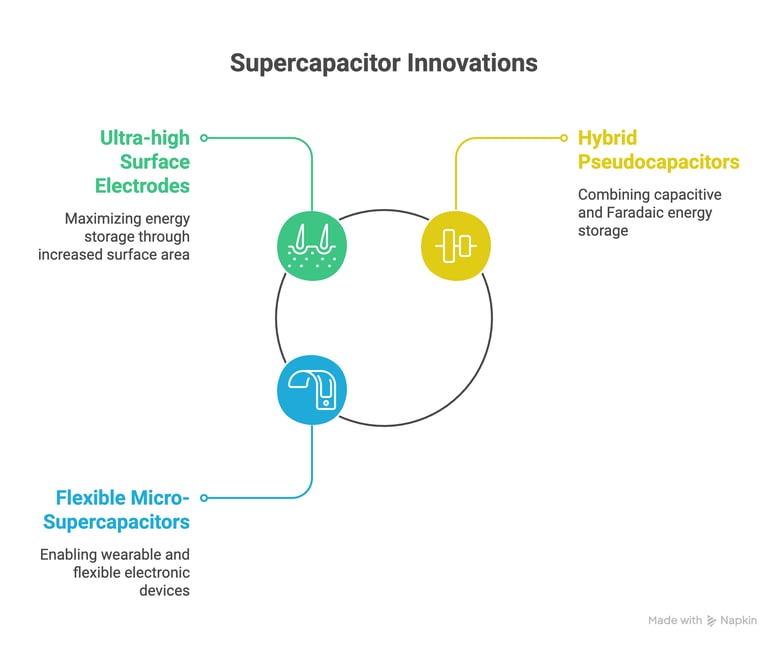
Recent breakthroughs in holey graphene architectures have pushed energy density beyond 85 Wh/kg, narrowing the gap with lithium-ion cells. The US Department of Energy's ARPA-E programme and the EU Graphene Flagship are co-funding hybrid graphene–pseudocapacitor systems targeting commercial energy density parity with batteries by 2028.
Environmental Benefits
Graphene supercapacitors present a compelling sustainability advantage over lithium-ion batteries: they contain no cobalt, lithium, or rare earth metals — eliminating the ethical and ecological burden of extractive mining. Their cycle life exceeds one million charge–discharge cycles with negligible performance loss, drastically reducing replacement frequency and e-waste.
The global graphene supercapacitor market is forecast to reach $4.6 billion by 2033, propelled by EV adoption, renewable energy integration, and industrial automation. Companies like Skeleton Technologies, Kilowatt Labs, and Nanotech Energy are commercialising graphene-enhanced ultracapacitor cells targeting automotive and grid OEMs.
Commercial Impact
Company
Mysore | Bangalore
carbun.lifesciences@gmail.com
Follow Us
Carbun Lifesciences
© 2026 Carbun Lifesciences All rights reserved.
Have a requirment for industry grade Graphene | G-Briquettes | GQD?